Menu
SHARI COOKSON
  • Home
  • FILMOLOGY
  • SCENEWORKS
  • MACKEREL SKY FILMS
  • BOOK
    • Gather
    • THE UNREQUITED VOTER BOOK
    • FILM
  • BLOG
  • CONTACT
  • Art Catalogue 25
  • Home
  • FILMOLOGY
  • SCENEWORKS
  • MACKEREL SKY FILMS
  • BOOK
    • Gather
    • THE UNREQUITED VOTER BOOK
    • FILM
  • BLOG
  • CONTACT
  • Art Catalogue 25

Skinhead wants to keep a low profile May 3, 1993 (Skinheads USA)

6/25/2023

0 Comments

 
Picture
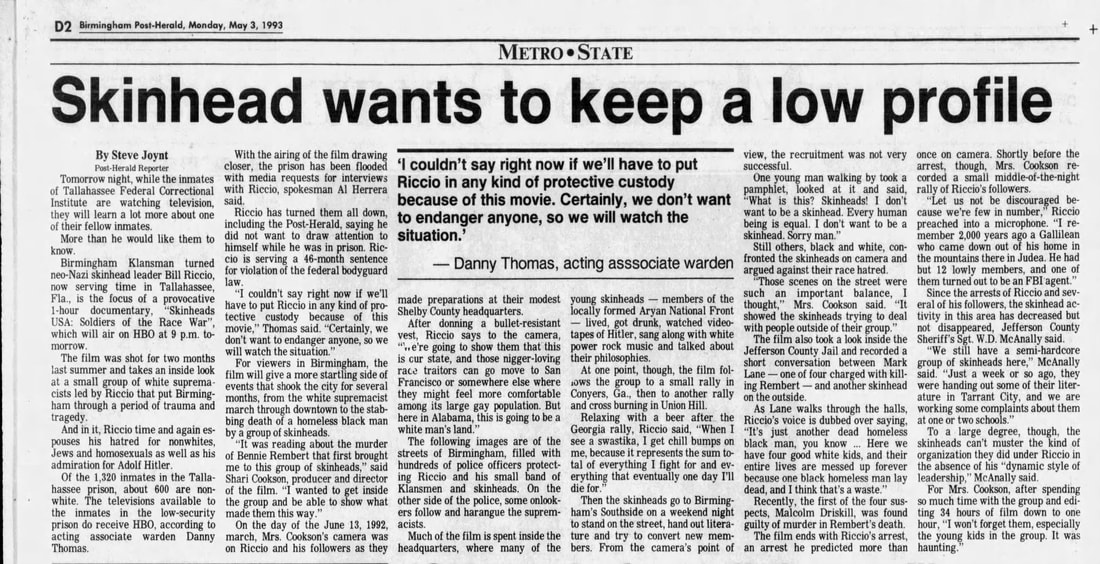
​Skinhead wants to keep a low profile
 
By Steve Joynt
Post-Herald Reporter
 
Tomorrow night, while the inmates of Tallahassee Federal Correctional Institute are watching television, they will learn a lot more about one of their fellow inmates.
 
More than he would like them to know.
 
Birmingham Klansman turned neo-Nazi skinhead leader Bill Riccio, now serving time in Tallahassee, Fla., is the focus of a provocative 1-hour documentary, “Skinheads USA: Soldiers of the Race War,” which will air on HBO at 9 p.m. tomorrow.
 
The film was shot for two months last summer and takes an inside look at a small group of white supremacists led by Riccio that put Birmingham through a period of trauma and tragedy.
 
And in it, Riccio time and again espouses his hatred for nonwhites, Jews and homosexuals as well as his admiration for Adolf Hitler.
 
Of the 1,320 inmates in the Tallahassee prison, about 600 are nonwhite.  The televisions available to them in the low-security prison do receive HBO, according to acting associate warden Danny Thomas.
 
With the airing of the film drawing closer, the prison has been flooded with media requests for interviews with Riccio, spokesman Al Herrera said.
 
Riccio has turned them all down, including the Post-Herald, saying he did not want to draw attention to himself while he was in prison.  Riccio is serving a 46-month sentence for violation of the federal bodyguard law.
 
“I couldn’t say right now if we’ll have to put Riccio in any kind of protective custody because of this movie,” Thomas said.  “Certainly we don’t want to endanger anyone, so we will watch the situation.”
 
For viewers in Birmingham, the film will give a more startling side of events that shook the city for several months, from the white supremacist march through downtown to the stabbing death of a homeless black man by a group of skinheads.
 
“It was reading about the murder of Bennie Rembert that first brought me to this group of skinheads,” said Shari Cookson, producer and director of the film.  “I wanted to get inside the group and be able to show what made them this way.”
 
On the day of the June 13, 1992 march, Mrs. (sic should be Ms.) Cookson’s camera was on Riccio and his followers as they made preparations at their modest Shelby County headquarters.
 
After donning a bullet-resistant vest, Riccio says to the camera, “We’re going to show them that this is our state, and those nigger-loving race traders can go move to San Francisco or somewhere else where they might feel more comfortable among its large gay population.  But here in Alabama, this is going to be a white man’s land.”
 
The following images are of the streets in Birmingham, filled with hundreds of police officers police officers protecting Riccio and his small band of Klansmen and skinheads. On the other side of the police, some onlookers follow and harangue the supremacists.
 
Much of the film is spent inside the headquarters, where many of the young skinheads – members of the locally formed Aryan National Front – lived, got drunk, watched videotapes of Hitler, sang along with white power rock music and talked about their philosophies.
 
At one point, though, the film follows the group to a small rally in Conyers, GA., then to another rally and cross burning in Union Hill.
 
Relaxing with a beer after the George rally, Riccio says, “When I see a swastika, I get chill bumps on me, because it represents the sum total of everything I fight for and everything that one day I’ll die for.”
 
Then the skinheads go to Birmingham’s Southside on a weekend night to stand on the street, hand out literature and try to convert new members.  From the camera’s point of view, the recruitment was not very successful.
 
One young man walking by took a pamphlet, looked at it and said, “What is this?  Skinheads!  I don’t want to be a skinhead.  Every human being is equal.  I don’t want to be a skinhead.  Sorry man.”
 
Still others, black and white, confronted the skinheads on camera and argued against race hatred.
 
“Those scenes on the street where such an important balance, I thought,” Mrs. Cookson said.  “It showed the skinheads trying to deal with people outside their group.”
 
The film also took a look inside the Jefferson County Jail and recorded a short conversation between Mark Lane—one of the four charged with killing Rembert—and another skinhead on the outside.
 
As Lane walks through the halls, Riccio’s voice is dubbed over saying, “It’s just another dead homeless black man, you know … Here we have four good white kids and their entire lives are messed up forever because one black homeless man lay dead, and I think it’s a waste.”
 
Recently, the first of the four suspects, Malcolm Driskill, was found guilty of murder in Rembert’s death.
 
The film ends with Riccio’s arrest, an arrest he predicted more than once on camera.  Shortly before the arrest, though, Mrs. Cookson recorded a small middle-of-the-night rally of Riccio’s followers.
 
“Let us not be discouraged because we’re few in member,” Riccio preached into a microphone.  “I remember 2,000 years ago a Gallilean who came down out of his home in the mountains there in Judea.  He had but 12 lowly members, and one of them turned out to be an FBI agent.”
 
Since the arrests of Riccio and several of his followers, the skinhead activity in this area has decreased but not disappeared, Jefferson County Sheriff’s Sgt. W.D. McAnally said.
 
“We still have a semi-hardcore group of skinheads here,” McAnally said.  “Just a week or so ago, they were handing out some of their literature in Tarrant City, and we are working some complaints about them at one or two schools.
 
To a large degree, though, the skinheads can’t muster the kind of organization they did under Riccio in the absence of his “dynamic style of leadership,” McAnally said.
 
For Mrs. Cookson, after spending so much time with the group and editing 34 hours of film down to one hour, “I won’t forget them, especially the young kids in the group.  It was haunting.”


Birmingham Post-Herald
 May 3, 1003
Page 18
 
 
Transcribed By: S Cookson
0 Comments


Leave a Reply.

    Author

    Archives

    June 2023

    Categories

    All

    RSS Feed

Proudly powered by Weebly