Menu
SHARI COOKSON
  • Home
  • FILMOLOGY
  • SCENEWORKS
  • MACKEREL SKY FILMS
  • BOOK
    • Gather
    • THE UNREQUITED VOTER BOOK
    • FILM
  • BLOG
  • CONTACT
  • Art Catalogue 25
  • Home
  • FILMOLOGY
  • SCENEWORKS
  • MACKEREL SKY FILMS
  • BOOK
    • Gather
    • THE UNREQUITED VOTER BOOK
    • FILM
  • BLOG
  • CONTACT
  • Art Catalogue 25

A Stroll Through the Mine Fields 12/6/1982 (USC Documentary Program)

6/25/2023

1 Comment

 
Picture
​Howard Rosenberg
 
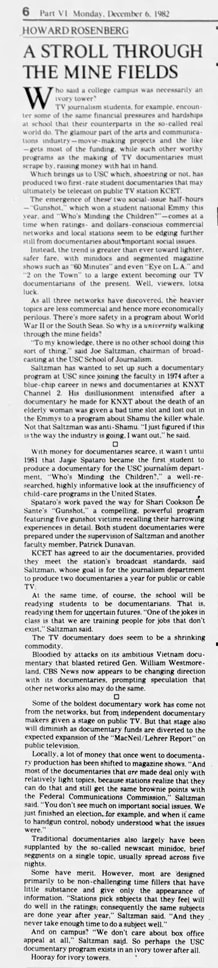
A Stroll Through the Mine Fields
 
Who said a college campus was necessarily an ivory tower?
 
TV journalism students, for example, encounter some of the financial pressures and hardships at school that their counterparts in the so-called real world do.  The glamour part of the arts and communications industry – movie-making projects and the like – gets most of the funding, while other such worthy programs as the making of TV documentaries must scrape by, raising money with hat in hand.
 
Which brings us to USC, which, shoestring or not, has produced two first-rate student documentaries that may ultimately be telecast on public TV station KCET.
 
The emergence of these two social-issue half hours – “Gunshot,” which won a student national Emmy this year, and “Who’s Minding the Children?” – comes at a time when ratings- and dollars-conscious commercial networks and local stations seem to be edging further still from documentaries about important social issues.
 
Instead, the trend is greater than ever toward lighter, safer fare, with minidocs and segmented magazine shows such as “60 Minutes” and even “Eye on L.A.” and “2 on the Town” to a large extent becoming our TV documentarians of the present.  Well, viewers lotsa luck.
 
As all three networks have discovered, the heavier topics are less commercial and hence more economically perilous.  There’s more safety in a program about World War II or the South Seas.  So why is a university walking through the mine fields?
 
“To my knowledge, there is no other school doing this sort of thing,” said Joe Saltzman, chairman of broadcasting at the USC School of Journalism.
 
Saltzman has wanted to set up such a documentary program at USC since joining the faculty in 1974 after a blue-chip career in news and documentaries at KNXT Channel 2.  His disillusionment intensified after a documentary he made for KNXT about the death of an elderly woman was given a bad time slot and lost out in the Emmys to a program about Shamu the killer whale. Not the Saltzman was anti-Shamu.  “I just figured if this was the way the industry is going, I want out,” he said.
 
*
 
With money for documentaries scarce, it wasn’t until 1981 that Janie Spataro became the first student to produce a documentary for the USC journalism department.  “Who’s Minding the Children?,” a well-researched, highly informative look at the insufficiency of child-care programs in the United States.
 
Spataro’s work paved the way for Shari Cookson DesSante’s  “Gunshot,” a compelling, powerful program featuring five gunshot victims recalling their harrowing experiences in detail.  Both student documentaries were prepared under the supervision of Saltzman and another faculty member, Patrick Dunavan.
 
KCET has agreed to air the documentaries, provided they meet the station’s broadcast standards, said Saltzman, whose goal is for the journalism department to produce two documentaries a year for public or cable TV.
 
At the same time, of course, the school will be readying the students to be documentarians.  That is, readying them for uncertain futures.  “One of the jokes in class is that we are training people for jobs that don’t exist,” Saltzman said.
 
The TV documentary does seem to be a shrinking commodity.
 
Bloodied by attacks on its ambitious Vietnam documentary that blasted retired Gen. William Westmoreland, CBS News now appears to be changing direction with its documentaries, prompting speculation that other networks might do the same.
 
*
 
Some of the boldest documentary work has come not from the networks, but from  independent documentary makers given a stage on public TV.  But that stage also will diminish as documentary funds are diverted on the expected expansion of the “MacNeil/Lehrer Report” on public television.
 
Locally, a lot of money that once went to documentary production has been shifted to magazine shows.  “And most of the documentaries that are made deal only with relatively light topics, because stations realize that they can do that and still get the same brownie points with the Federal Communications Commission,” Saltzman said. “You don’t see much on important social issues.  We just finished an election, for example, and when it came to handgun control, nobody understood what the issues were.”
 
Traditional documentaries also largely have been supplanted by so-called newscast minidoc, brief segments on a single topic, usually spread across five nights.
 
Some have merit.  However, most are designed primarily to be non-challenging fillers that have little substance and give only the appearance of information.  “Stations pick subjects that they feel will do well in the ratings: consequently the same subjects are done year after year,” Saltzman said.  “And they never take enough time to do a subject well.”
 
And on campus?  “We don’t care about box office appeal at all,” Saltzman said.  So perhaps the USC documentary program exists in an ivory tower after all.
 
Hoorah for ivory towers.
 
Los Angeles Times
12/8/1982
Page 82
 
Transcribed By: S Cookson
1 Comment
Farnborough Spanking link
7/18/2025 07:27:49 pm

It's inspiring that USC is producing high-quality student documentaries on important social issues.

Reply


Leave a Reply.

    Author

    Archives

    June 2023

    Categories

    All

    RSS Feed

Proudly powered by Weebly